
Academic writing
Redesigning Anatomy and Physiology Courses for Online Delivery
By Suzannah Alexander
April 18, 2021
In a scenario where a professor must translate existing human anatomy and physiology courses to be delivered asynchronously online, detailed planning and technological tools must be used to replace the traditional face-to-face lectures and laboratory components. Each part of the course must be analyzed to determine how to effectively deliver the educational materials online without losing critical teaching opportunities. The first step in redesigning the courses is to analyze the learning objectives and determine how they should be adjusted (Piskurich, 2015). In traditional human anatomy and physiology courses, some objectives require memorization and recall, like naming all bones in the body, while others require a more complex understanding of physiological processes. Some concepts easily adapt to an online format, while others like the laboratory dissections are more challenging. Luckily, learning technologies have advanced in recent years such that learning human anatomy and physiology online is completely within reach (Spector, 2016).
Defining the Critical Course Objectives
The learning objectives for the course must first be established. In this case, the objectives generally include how basic biological concepts relate from the cellular level to more complex body systems and physiological processes. The course is typically divided into two semesters so that all body systems can be covered in depth. Students must define and describe the major tissue types along with their locations, structures, and functions. Students then study the different organs and body systems, including the integumentary, skeletal, muscular, nervous, endocrine, blood and cardiovascular, lymphatic, immune, respiratory, digestive, urinary, and reproductive systems. Each course contains a large volume of information to not only memorize and recall, but also to visualize, comprehend, and explain in detail.
In the first semester, for example, students must not only be able to name all the bones in the body, but also the major joints and sites for muscle attachment. Moreover, they must be able to describe the process by which bones form and heal after damage. Students must be able to name the major components of the nervous system, describe the different types of nerves and their anatomical characteristics, and describe the physiological processes by which nerves transmit information throughout the body. Students must be able to name all the major muscles, describe how muscles interact with nerves, relay the various structures and their functions, and explain the biochemical mechanisms by which muscles act. In addition, students must be able to identify the major anatomical components of the endocrine system as well as each organ’s function and effect on the body. The second semester is similar in scope, as it covers the remaining body systems.
In any online course, students should first be introduced to the syllabus, instructor, and types of content to be covered. The student conduct policies, course expectations, rubrics, and grading system should also be outlined. As such, links to important documents should be easily accessible. Essentially, students should be given everything they need to be successful in the course, so they can prepare to tackle the content (Piskurich, 2015).
Traditional Course Components
In traditional human anatomy and physiology courses, lectures are given face-to-face in one-hour blocks, readings are assigned from a textbook and laboratory manual, and a face-to-face laboratory component is also required. Weekly modules progress through each body system, and students may also use study guides, coloring books, photo atlases, and other materials to supplement their learning. Typically, students can access e-books, animations, online quizzes, and other materials if they use the textbook packages supplied by major publishers, such as Pearson, McGraw-Hill Education, or Cengage Learning. Designing an online course using major publishers’ assets is much easier, as most supply all the tools needed to deliver the material in an online environment. These assets, however, are copyrighted and cannot be used without permission or a special agreement with the publisher. In this case, original, free, and open-access materials should be used instead so that the course can be offered to anyone, anywhere in the world, at any time and at no cost.
Part of the challenge in offering these courses for free is that creating assets, such as videos and animations, can be expensive, but other solutions can be explored if the budget is limited. Today, free online medical education, or FOAMed, is available in abundance; given enough time to find quality resources, many videos, animations, podcasts, and other online materials are available to link to the course. If a low-cost textbook option is needed, then a free online human anatomy and physiology textbook, like the one offered by OpenStax, can be used (OpenStax, 2013). Free laboratory manuals for Human Anatomy and Physiology I and II are also available from the University of Georgia (Hesse, et al., 2017; Massey, et al., 2019). A free photo atlas is even available from Kenhub.com (n.d.). Assignments can include traditional textbook readings as well as relevant case studies from peer-reviewed journals or other open-source materials.
Redesigning the Course for an Online Format
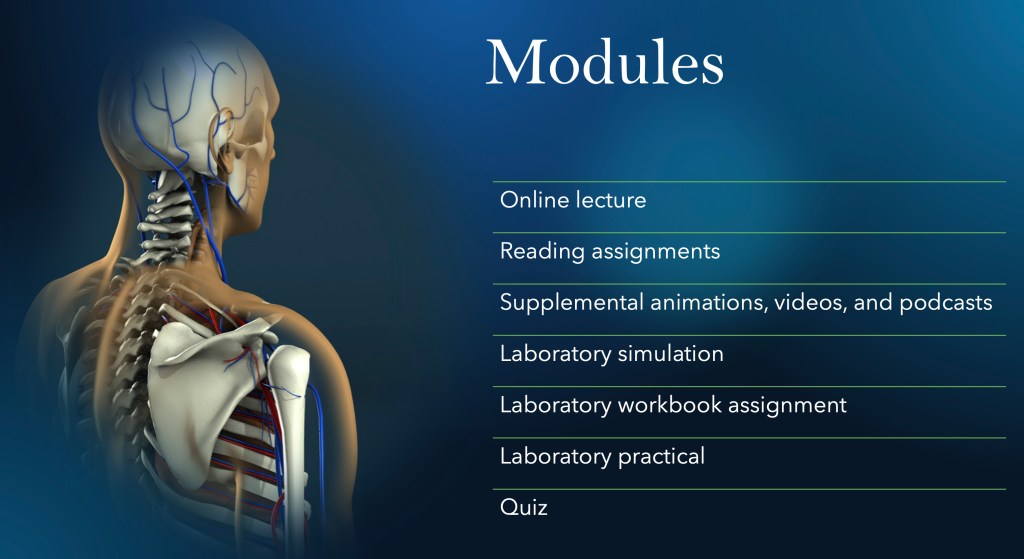
In an online format, body system modules should be created within the learning management system and should include online lectures; reading assignments; supplemental animations, videos, and podcasts; laboratory simulations, workbook assignments, and practicals; and module quizzes that cover all the material (Figure 1). Each of these components should be clearly outlined so that students can explore them on their own. Because these courses are being offered free online to anyone, anywhere in the world, they can be self-paced and self-contained with automatic feedback, if desired. Everything students need to be successful should be integrated into the course.
Figure 1
Modular components to cover each body system
Lectures can be recorded and broken up into smaller, more easily digestible chunks, such as time blocks of less than 20 minutes. There are many options for creating online lectures. Some institutions can record lectures in front of screens where instructors draw on a clear board with fluorescent markers; the board is later inverted for the viewer of the video. If this or other whiteboard technology is unavailable, however, Microsoft PowerPoint can be used to create slides; voiceover and video of the instructor talking through the presentation can be added. To ensure these videos stay accurate for a long time, only well-established concepts should be recorded. Newer concepts that are still being researched may be better explored by other means, so they can be updated as information changes. In addition to online lectures, lecture notes and PowerPoint slides can be provided to students.
Reading assignments can include textbook chapters, online case studies, and other journal articles that are appropriate for the discussion. Photos, videos, animations, and podcasts can all be linked to supplement the material and to provide students with a wide variety of learning options. Other materials can include online practice quizzes, study guides, photo atlases, and case banks. Anatomy can also be explored via 3D programs such as BioDigital or the Visible Body Courseware if the institution can arrange contracts with these companies (BioDigital, n.d.; Visible Body, n.d.). The advantage of studying anatomy through a 3D program is that the learner can explore tissues, organs, systems, and body processes from different perspectives and see how they are integrated with and dependent on each other. Moreover, physiological processes can be taught through stepped illustrations or animations, and laboratory exercises can be taught via online dissections and simulations.
Human Anatomy and Physiology I and II are intense courses with heavy memorization requirements, so quizzes are necessary to check in with students and note their progress. In this type of course, flash cards are also a good way to promote self-quizzing. Exams should be given several times throughout each semester covering each body system, a midterm exam can be offered half-way through each semester, and a final exam can be administered at the very end of each semester. Quizzes and exams can include a variety of question styles, such as labeling (e.g., bones, muscles, and other anatomical features), matching (e.g., structures to functions), multiple-choice (e.g., both recall and synthesis questions), and sequencing (e.g., to explain processes). In online courses, grading should be automated. The easier it is for students to receive feedback quickly, the better. Grading can also be optional for those not taking the course for credit.
It is important to offer students a discussion forum as well. In online courses that may not be routinely monitored, discussion boards can be created where students can start discussion threads on their own and instructors can monitor them as they have time and availability. Other ideas for open communication between instructors and students are online office hours or availability through email. Connecting with the instructor and other students can be tricky for students in different time zones, but at least some communication options should be offered so that students have an opportunity to clarify questions that arise.
Adapting the Laboratory Component to an Online Format
Again, laboratory exercises can be delivered with tools like the Visible Body Courseware or via online videos (Visible Body, n.d.). Histology can be delivered via photographs and microscopy simulations. Virtual cadavers can be used for dissections, the benefit being that students can peel back layers, view anatomy at different angles, and get a better idea of how various tissues and organs interact with each other. There are also quality options for online video dissections of hearts, brains, pigs, cats, and even humans. Depending on the needs of the course, an online solution can be found.
In addition, workbook assignments can be offered. There are open-access laboratory workbooks that can be used, or activities can be built to address specific teaching points, such as interactive animations, drag and drop exercises, and other online tools (Sheldahl, 2016). Laboratory practicals can be administered, using the same question types as for the examinations—labeling, matching, multiple choice, and sequencing.
Key Things to Consider in Online Delivery
Some major considerations in online course delivery are the amount of time it takes to create the materials and the cost to create, host, and monitor such courses year-round. The learning materials needed to explain human anatomy and physiology concepts are time intensive as well as expensive to create at high quality. However, with the quality of the materials already created and posted online, it is still completely reasonable to find, adapt, and create great resources for students.
Another hurdle in this type of learning environment is communication. Without a traditional student–instructor relationship, students may not have the support they need to be successful. The institution must find some way, via delayed communication like discussion boards or email, to help students when they get stuck during the learning process. Keeping students engaged in an online environment is also problematic. Although this course is self-paced, time limits may need to be enforced to ensure that students continue to progress. In other words, a little positive pressure may be needed to ensure students complete the courses.
Because Human Anatomy and Physiology I and II are challenging, remediation opportunities and study tips may also need to be offered. For example, students may need to be offered mnemonic devices or memory palace examples to help organize and remember the information. Labeling exercises and coloring books may need to be provided to help learn the material in different ways. Flash cards may also need to be provided or encouraged as a study tool to drill the information. There are many ways to encourage self-directed study, but a module outlining these suggestions may need to be created and delivered at the beginning of each course.
Key Take-Away Points
Everything that is needed to teach human anatomy and physiology concepts is either readily available online or can be created with the right tools. Students’ experiences can be enriched by creating unique lectures, practice quizzes, and other interactive activities. Because anatomy and physiology are visual topics, it is vital to connect students with a wide variety of illustrations, animations, and videos to explain the concepts and physiological processes. Essentially, online learning is an opportunity to create and enhance the traditional lectures, textbooks, and laboratory exercises to give students more ways to engage with the material and to perhaps improve learning outcomes.
References
BioDigital. (n.d.). https://www.biodigital.com/
Hesse, D., Cozart, D., Szymik, B., & Nichols, R. (2017). UGA Anatomy and Physiology 1 Lab Manual (3rd ed.). Biological Sciences Open Textbooks. https://oer.galileo.usg.edu/biology-textbooks/13
KenHub. (n.d.). Free online atlas: Anatomy of the human body. https://www.kenhub.com/en/get/human-anatomy-atlas
Massey, A., Beebe, L., & Hesse, D. (2019). UGA Anatomy and Physiology 2 Lab Manual
(3rd ed.). Biological Sciences Open Textbooks. https://oer.galileo.usg.edu/biology-textbooks/14
OpenStax (2013). Anatomy and Physiology. https://openstax.org/details/books/anatomy-and-physiology
Piskurich, G. M. (2015). Rapid instructional design: Learning ID fast and right (3rd ed.). John Wiley & Sons.
Sheldahl, L. C. (2016, July 21). Lab homework: Anatomy & Physiology. https://drive.google.com/file/d/1Ww_VnvqxspgnknT9sQim8Cot3XXxtdbB/view?usp=sharing
Spector, J. M. (2016). Foundations of educational technology: Integrative approaches and interdisciplinary perspectives (2nd ed.). Routledge.
Visible Body. (n.d.). https://www.visiblebody.com/
 Suzannah Alexander